What is high bay vs low bay lighting? The answer starts with ceiling height, but it does not end there. High-bay fixtures are commonly used in spaces with ceilings around 20 feet or higher, such as warehouses, factories, and gymnasiums. Low-bay fixtures are generally suited to lower ceilings, including workshops, retail areas, and smaller storage rooms. These ranges are practical guidelines, not universal cutoffs. Check each fixture’s specifications before making a decision.
That distinction matters. At a 30-foot ceiling, a narrow beam may help direct light toward floors or work areas. In a lower room, the same fixture could create uncomfortable glare or uneven coverage. Low-bay optics are typically designed for shorter mounting heights, but room layout still affects performance. Look beyond labels. Compare beam angle, mounting height, target light levels, spacing, and the tasks people perform beneath each fixture. A warehouse aisle has different needs from a machine bench or shop counter.
There is no perfect shortcut. A fixture’s lumen rating alone cannot show whether light will land where it is needed. Consider controls, maintenance access, and the cost of replacing lamps or drivers over time. When possible, review photometric data or test a sample in the actual space. Product categories can overlap, and manufacturer guidance may differ. A careful comparison helps you choose lighting that supports visibility without wasting energy or creating harsh bright spots.
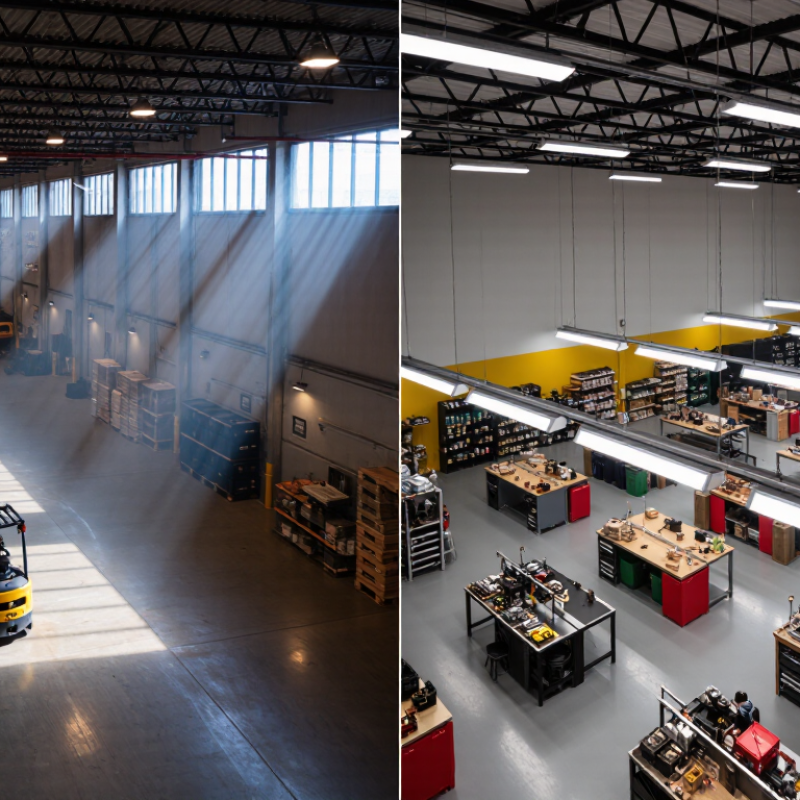
High bay and low bay describe how luminaires are designed to serve different ceiling heights and lighting conditions. High bay fixtures are commonly used in spaces with ceilings around 20 feet or higher, such as warehouses, gyms, and large workshops. They often use carefully controlled optics to send light down to floors, shelving, or work areas. Without that control, bright ceiling fixtures can leave the floor dim or create glare.
Low bay lighting is generally intended for lower ceilings, often roughly 12 to 20 feet high. It suits smaller workshops, retail areas, and utility rooms. The shorter distance to the floor usually calls for a different light distribution, not simply a less powerful fixture. A broad beam can spread light across benches or aisles without concentrating it in a small patch.
These height ranges are useful starting points, not strict rules. Ceiling structure, mounting position, surface reflectance, and the task below all affect the result. A 16-foot ceiling with tall shelving may need a different layout from an open room at the same height. That distinction matters. Check the fixture’s photometric data and plan spacing before installation; selecting by the “high bay” or “low bay” label alone can miss dark areas or produce uncomfortable glare. The labels sound exact, but they leave room for judgment.
Ceiling height is the first clue when choosing high bay or low bay lighting. Low bay fixtures commonly suit ceilings below about 20 feet, while high bays are generally designed for taller spaces. These ranges are guidelines, not hard rules. A 17-foot workshop with dark shelves may need different optics from a bright, open room at the same height. The fixture’s beam pattern, output, spacing, and mounting position all affect how evenly light reaches the floor. More lumens alone will not fix a poorly matched beam.
Tips: Measure the mounting height, not just the ceiling. Check the fixture layout against aisles, workbenches, and shelving. If possible, review a photometric plan before installation.
At greater heights, a narrow beam can help deliver light to the floor, but it may leave dim areas between fixtures. Low bay lighting often spreads light over a wider area at closer range. Consider glare, too: a bright source in a worker’s direct line of sight can make detailed tasks uncomfortable. A rule of thumb can be useful, but it is easy to trust it too much. Reflective floors, high-bay racks, and changing work zones can shift the result. Recheck the plan for actual room conditions, including maintenance access and any existing daylight.
| Selection Factor | High Bay Lighting | Low Bay Lighting |
|---|---|---|
| Typical mounting height | Commonly used at heights of about 20 ft (6 m) and above. | Commonly used below about 20 ft (6 m). |
| Typical spaces | Warehouses, distribution centers, factories, and large indoor sports facilities. | Small workshops, garages, retail areas, and rooms with lower ceilings. |
| Light distribution | Often paired with optics designed to direct light down from greater heights and cover broad floor areas. | Usually designed to provide useful light over a shorter distance, with distribution selected to suit the room layout. |
| Fixture output and spacing | May require higher-output fixtures or carefully planned spacing so light reaches the work plane. The layout depends on room dimensions, mounting height, and required illuminance. | Often uses lower-output fixtures than a comparable high-ceiling installation. Spacing should still be checked to avoid dark patches and uneven light. |
| Glare considerations | Check fixture optics, shielding, and viewing angles, especially where workers look toward elevated fixtures or operate equipment. | Fixtures are closer to occupants, so glare control and comfortable viewing angles are especially important. |
| Installation and maintenance | Installation and servicing may require lifts or other access equipment, depending on the building and mounting arrangement. | Fixtures are generally easier to reach, although access depends on the room and installation. |
| How to choose | Consider when the ceiling is high and the light must reach a distant floor or work surface. Confirm photometric performance for the specific layout. | Consider when the ceiling is lower and fixtures need to provide comfortable, appropriately distributed light at shorter distances. |
Note: The 20 ft (6 m) distinction is a common rule of thumb, not a universal cutoff. Fixture selection should be based on a lighting calculation that accounts for ceiling height, room dimensions, task requirements, reflectance, and applicable lighting standards.
Why Choose High Bay vs Low Bay Lighting?
How Beam Spread and Light Distribution Differ
High-bay and low-bay labels often describe mounting height, but the cutoff varies by application. A common rule of thumb places low bays below 20 feet and high bays above it. Beam spread determines where light lands: narrow optics concentrate light on tall racks, while wider optics suit open floors and lower ceilings. Neither is automatically better.
Beam angle is commonly measured between points where intensity falls to 50% of its peak. As a geometric example, a 90-degree beam mounted 30 feet high spans about 60 feet across at that level. That is not a promise of even illumination; the beam edges may be too dim for the task. IES LM-79-19 photometric testing reports luminous output and intensity distribution, useful data for comparing actual fixtures rather than relying on labels alone. Still, a photometric file cannot fully predict glare from shiny floors or shelving.
Tips: Request the IES photometric file and model the actual mounting height, aisle width, and spacing. Check both work-plane illuminance and uniformity. A narrow beam can leave dark gaps between aisles. I’ve seen that rule of thumb mislead people: the room layout matters just as much.
Why Choose High Bay vs Low Bay Lighting?
The space decides more than the fixture label. High bay lighting suits ceilings above 20 feet, where warehouses, aircraft hangars, distribution centers, and indoor sports courts need controlled, long-range beams. Low bay fixtures work better below 20 feet. Consider workshops, retail areas, parking structures, service corridors, and smaller production rooms. The 20-foot boundary is widely used, but it is not perfectly universal. Ceiling color, rack height, dust, and task detail can change the right choice.
The U.S. Department of Energy reports that LED lighting uses at least 75% less energy than incandescent lighting and can last up to 25 times longer. That figure does not compare high bay directly with low bay systems. It does show why efficient industrial retrofits deserve careful planning. IES guidance emphasizes maintained illuminance, uniformity, glare control, and visual comfort. A narrow high bay beam may brighten a rack aisle but leave nearby floor areas dim. A low bay fixture mounted too high may create weak, uneven light.
Tips: Measure mounting height before selecting optics. Check actual foot-candles at work surfaces. Review glare near forklifts, screens, and polished floors. Photometric files can help, but field conditions still matter. I have seen layouts look excellent on paper and disappoint after dust, shelving, or paint changes the result. Allow room for adjustment.
Choosing between high bay and low bay lighting starts with the room, not the catalog. I have seen fixtures installed too low, creating harsh pools and dark aisles. Measure mounting height, ceiling structure, aisle width, and work-plane needs before comparing wattage. High bays generally suit ceilings above 20 feet, while low bays often serve lower spaces. However, height ranges overlap. The task decides more than the label.
Compare delivered lumens, beam angle, and uniformity together. A narrow beam can reach distant floors, but it may create bright spots. A wider beam improves coverage, yet can increase glare on glossy machinery. Check the fixture’s photometric file and review average-to-minimum illumination. Do not trust lumen numbers alone. Look beyond wattage. Compare color temperature, color rendering, dimming, occupancy controls, and emergency operation. Small control errors can waste energy every night.
The environment matters too. Dust, humidity, heat, vibration, and cleaning routines should guide ingress and impact ratings. Confirm ambient-temperature limits and mounting accessories before ordering. Look for tested performance, safety certifications, warranty terms, and documented maintenance procedures. A five-year energy estimate is useful, but replacement access may matter more. I still question quick payback claims when labor costs are ignored. A practical comparison includes light quality, installation risk, service time, and worker comfort—not just purchase price.
High bays generally suit ceilings above 20 feet. Warehouses, hangars, and indoor courts often need their longer-reaching beams.
Low bays often work below 20 feet. Workshops, retail areas, service corridors, and smaller production rooms are common examples.
No. Ceiling color, rack height, dust, and task detail can change the right choice. Measure the actual space.
A narrow beam can brighten a tall rack aisle but leave nearby floors dim. A wider beam covers more area, though glossy surfaces may glare.
Compare delivered lumens, beam angle, and light uniformity. Also review color quality, dimming, controls, and emergency operation.
Review photometric files and measure foot-candles on work surfaces. A paper plan may miss dust, shelving, or dark ceiling paint.
Dust, humidity, heat, vibration, and cleaning routines matter. Check temperature limits, impact protection, and mounting accessories before ordering.
Include energy, installation, replacement access, and service labor. Quick payback estimates can overlook labor costs. I would check those assumptions twice.
Usually not. Different ceiling heights and tasks need different beam patterns. I have seen neat layouts disappoint in the field.
Understanding what is high bay vs low bay lighting starts with ceiling height, fixture placement, and the way light needs to reach the working surface. High bay fixtures are designed for taller ceilings, typically where light must travel a greater distance, while low bay fixtures suit lower ceilings and can provide effective illumination without excessive glare or wasted output. The right choice also depends on beam spread: narrower beams can concentrate light over distant areas, while wider distributions are often better for lower mounting heights and broad coverage.
High bay lighting is commonly suited to warehouses, factories, sports facilities, and other large spaces with high ceilings. Low bay lighting may be more appropriate for workshops, retail areas, garages, and rooms with modest ceiling heights. Before selecting a fixture, compare mounting height, room dimensions, required brightness, beam angle, light distribution, energy use, maintenance needs, and visual comfort. A balanced evaluation helps create consistent, efficient, and practical illumination for the space.

Habel Lighting